
Two ways to grow your savings
Start with a lump sum
$10,000 invested for 10 years at a constant 5% nominal annual rate, with no further deposits.
$16,470.09
$6,470.09 interest earned.
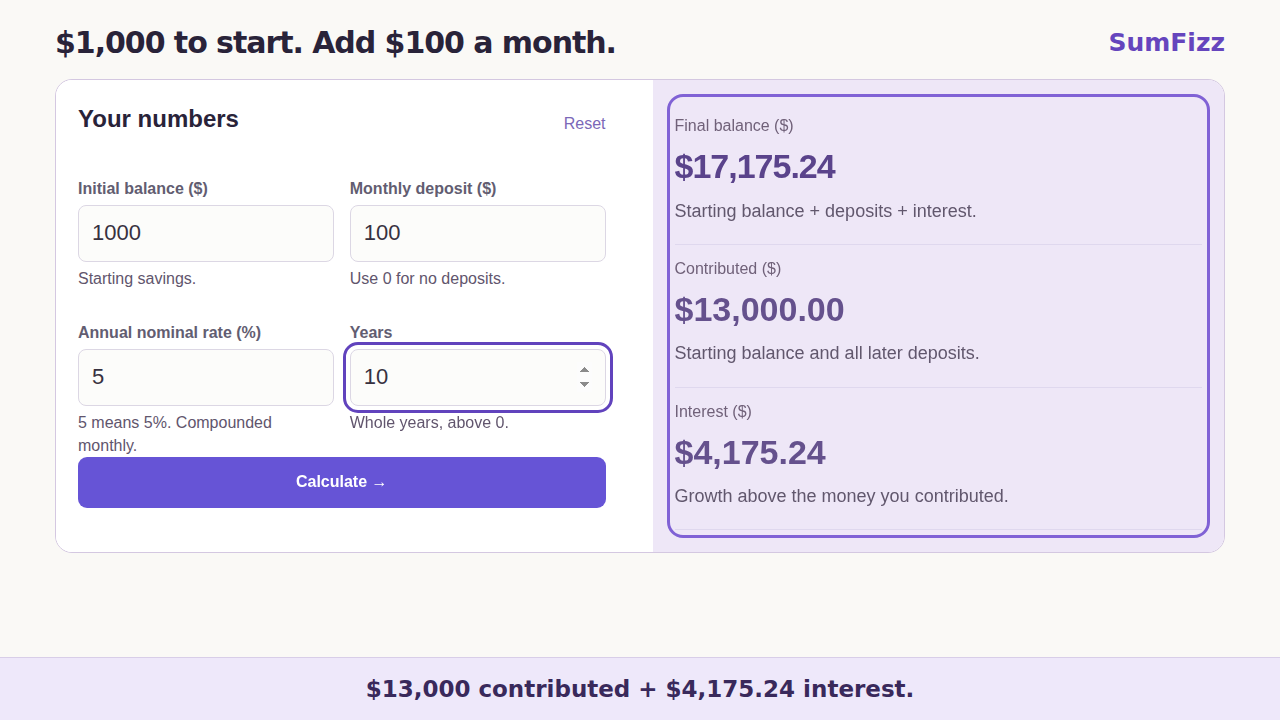
Add money each month
Start at zero and add $100 a month for 10 years at the same 5% nominal annual rate.
$15,528.23
$12,000 contributed; $3,528.23 interest.
Both examples use monthly compounding and month-end deposits. Fees, taxes and inflation are excluded.
Formula and calculation method
Compound interest formula
Each month, interest is added to your balance, followed by your deposit.
A = P(1 + i)n + M × ((1 + i)n − 1) ÷ i
- P
- Starting balance
- M
- Monthly deposit
- i
- Monthly rate: annual nominal rate (%) ÷ 1200
- n
- Number of months: years × 12
- A
- Final balance
At 0% interest, A = P + M × n. Total contributions = P + M × n; interest earned = A − total contributions.
Use this calculation in Excel
Enter your inputs in these cells, then paste the formula into B6.
- B2
- Starting balance
- B3
- Monthly deposit
- B4
- Annual nominal rate: enter 5 for 5%
- B5
- Years
=FV(B4/1200,B5*12,-B3,-B2,0)The final 0 means deposits are made at month end. Negative deposit and starting-balance arguments follow Excel’s cash-flow convention. This uses English function names and comma separators.
Assumptions & limits
Assumptions & limits
The nominal annual rate stays constant and is divided by 12. Deposits arrive at month end. Withdrawals, fees, taxes and inflation are excluded. Results are illustrative; returns are not guaranteed.
Quick answers
What is compound interest?
Interest earns more interest: each new period starts with a balance that includes interest already added.
Can I calculate growth without monthly deposits?
Yes. Set the monthly deposit to 0 to see how your starting balance grows on its own.
How does monthly compounding work?
The calculator divides your nominal annual percentage rate by 1200 to get a monthly decimal rate, then applies it to the balance before adding that month’s deposit.
How is this different from simple interest?
Simple interest is calculated on the original principal. Compound interest also earns interest on earlier interest. Try the simple interest calculator.
Are these inputs private?
These calculations run in your browser. A shared link contains the values you choose to share. Only questions submitted to the separate AI finder are sent to OpenAI.
Further reading
Investor.gov: financial planning tools ↗
Background reading; this does not imply endorsement or independent review of SumFizz.